Steve Borgatti on node-level homophily
The second seminar of the Frontiers in Social Network Research series, with Steve P. Borgatti of the University of Kentucky.
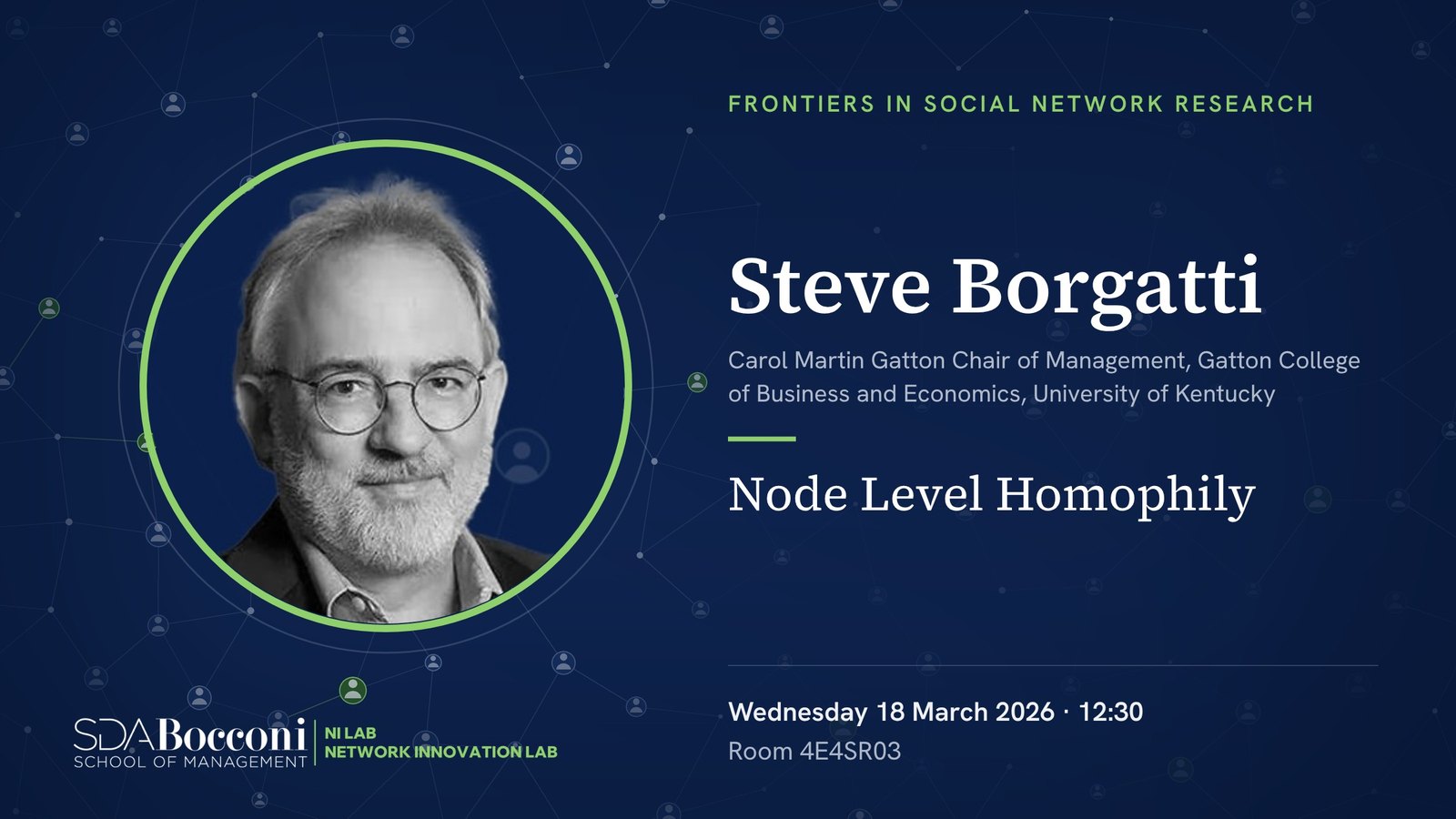
The SDA Bocconi Network Innovation Lab hosted the second seminar of the series Frontiers in Social Network Research.
“Node Level Homophily”
Speaker: Steve P. Borgatti, Carol Martin Gatton Chair of Management, Gatton College of Business and Economics, University of Kentucky
When: Wednesday 18 March 2026, 12:30
Where: Room 4E4SR03
Abstract
Researchers distinguish between raw homophily (the observed rate of interaction with similar others) and choice homophily (the preference for similar others, adjusted for opportunity). But what exactly distinguishes these concepts, and how well do existing measures capture the distinction? This paper begins with a surprising statistical fact: regressing an outcome on a raw homophily measure while controlling for the node attribute on which homophily was calculated effectively transforms raw homophily into a measure of choice homophily. This explains why raw and choice homophily measures often yield similar regression results, and why researchers whose theories depend on raw homophily must not include the node attribute as a control.
To make this relationship exact and transparent, we construct a new measure of choice homophily called h* which has a number of nice properties, but in this paper serves primarily as a conceptual device: in Lévi-Strauss’s words, an idea that is good to think with. Unpacking what h* does and does not capture reveals that any choice homophily measure depends on a baseline model specifying expected ties, and that different baselines encode different assumptions about the social processes generating ties.
This observation motivates a broader examination of homophily measures, which fall into two fundamentally different approaches: excess within-group ties measures, which compare observed ties to a null model, and correlational measures, which treat homophily as attribute similarity among connected nodes. Comparing these approaches exposes foundational questions about what we want homophily measures to tell us and what properties good baseline models should have.