Pay-for-prominence: what happens when companies pay employees to be central
In the Strategic Management Journal, Alessandro Iorio, Giuseppe Soda and Brandy Aven study a company that paid a bonus for becoming a knowledge hub. Employees doubled their contacts, and the most central became more likely to leave.
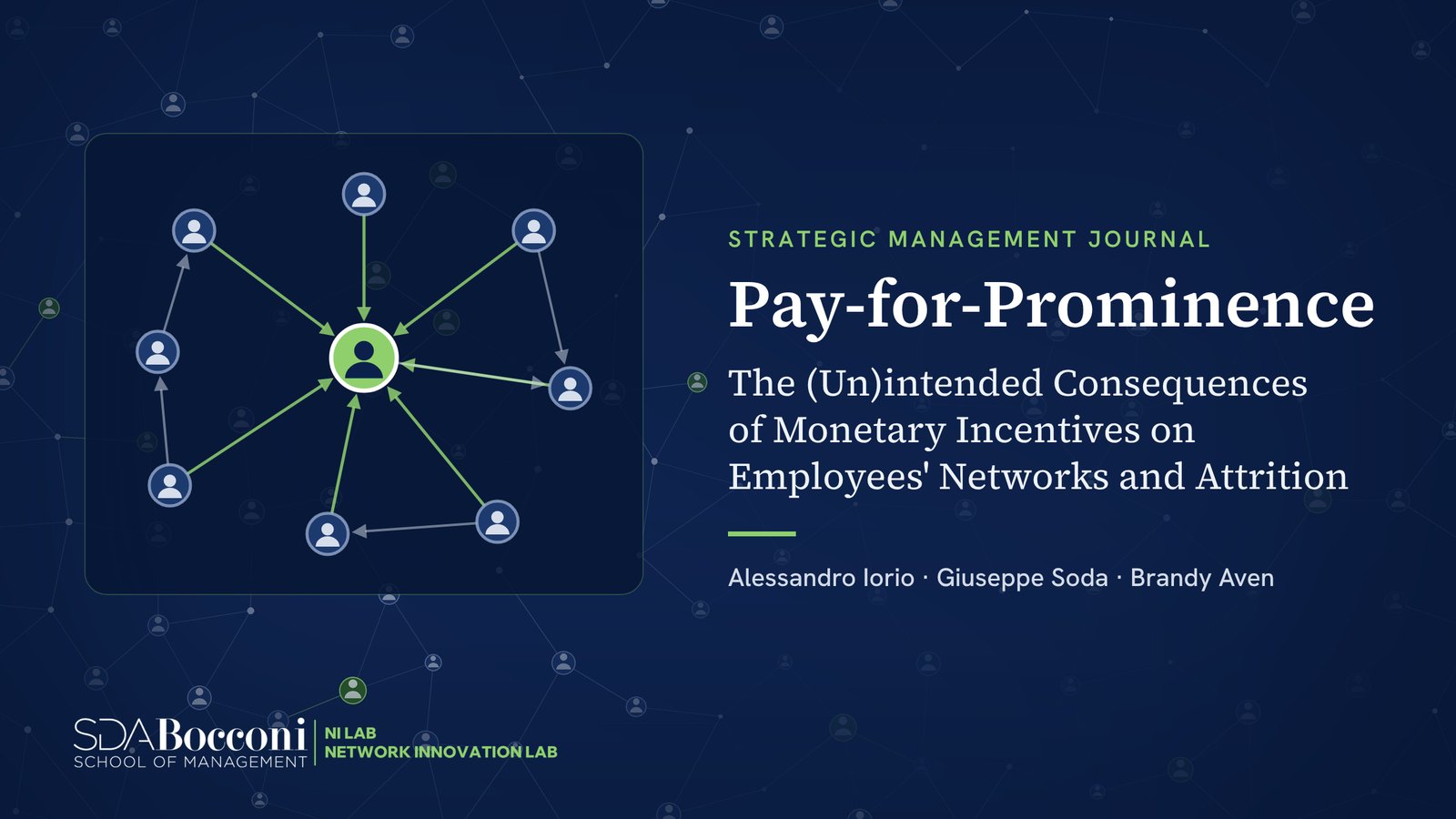
What if your bonus depended on how many colleagues come to you for advice, knowledge, information and ideas? Not popularity in the social-media sense, but being seen as a source of knowledge inside your organization.
A new paper by Alessandro Iorio, Giuseppe “Beppe” Soda and Brandy Aven, just published in the Strategic Management Journal, studies a company that did exactly that.
The experiment
A multinational company wanted knowledge, information and ideas to flow more widely across the organization. To get there, it changed its management-by-objectives system so that employees could earn a bonus for becoming more central in the informal knowledge network: the more colleagues saw them as a knowledge provider, the larger the bonus. The authors studied what happened through a field quasi-experiment.
What happened
People responded. Employees with the incentive reached beyond their usual circles and became more sought after by colleagues. They roughly doubled the number of colleagues they turned to.
Relationships changed in nature. Workplace relationships usually run on reciprocity: people help each other because they are colleagues, not because they are paid to. Once money enters the picture, relationships can start to look less like social bonds and more like transactions, with a contact becoming a metric to improve.
The most central people left. The more central employees became, the more likely they were to leave the company. The organization paid people to become knowledge hubs, and then faced a greater risk of losing the very people who connected everyone else.
Why it matters
Companies increasingly want to measure and reward collaboration. The study shows that it is possible to put a price on workplace relationships, and that people will respond to it, but the consequences for how relationships work and for who stays in the organization are much harder to price.
The paper: Iorio, A., Soda, G., & Aven, B. (2026). Pay-for-prominence: The (un)intended consequences of monetary incentives on employees’ networks and attrition. Strategic Management Journal, 1–34.