The ties that nurture: how trusted relationships help brokers perform
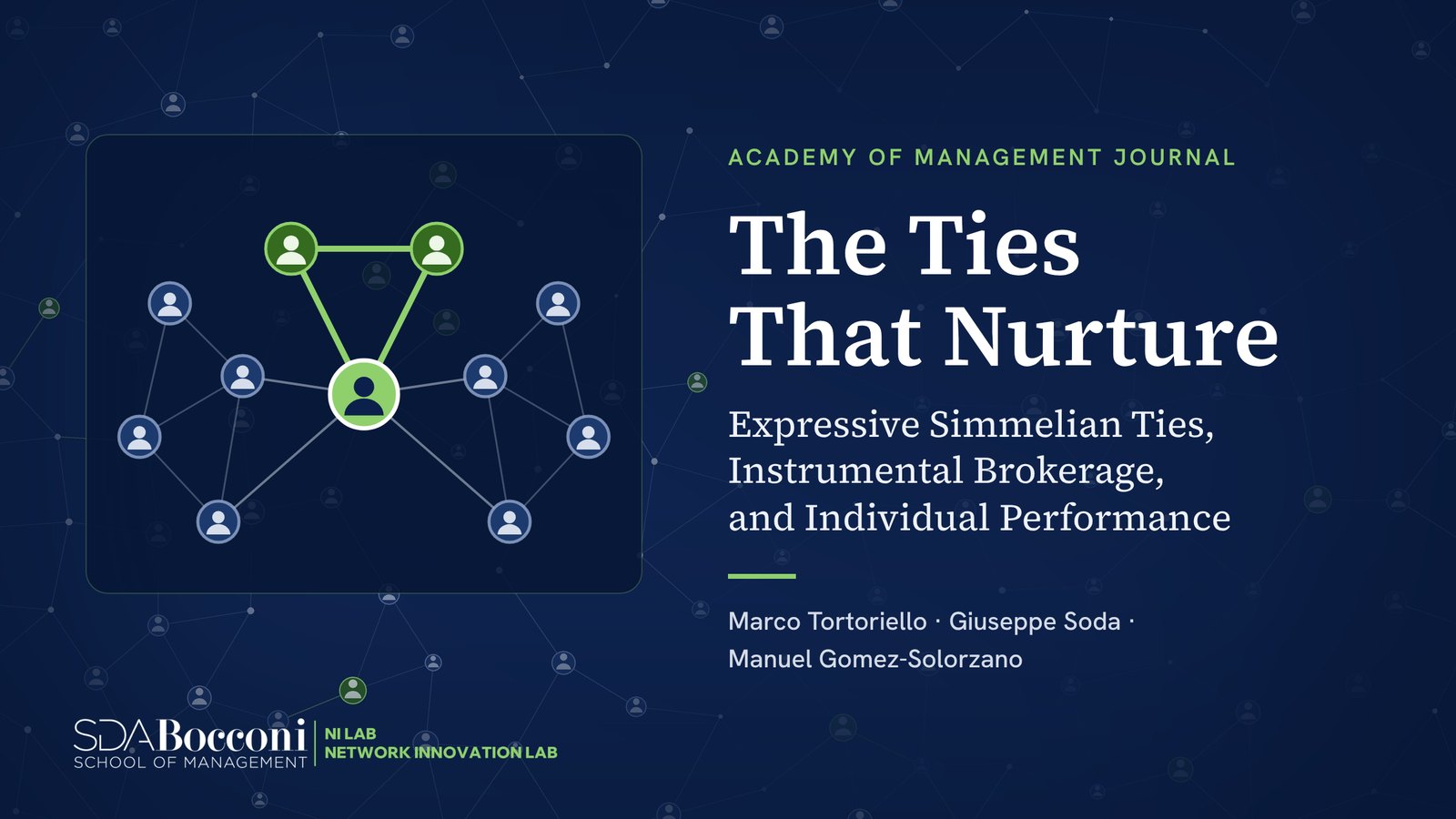
New research by Marco Tortoriello, Giuseppe Soda and Manuel Gomez-Solorzano in the Academy of Management Journal shows that brokers perform best when they can also count on a close circle of trusted colleagues.
People who sit between groups that would otherwise not talk to each other, the brokers of an organization, are often among its best performers. They see information that others miss and can combine ideas from different parts of the company. But the position has a cost: brokers are exposed to conflicting demands, more stress and a degree of isolation.
A new paper by Marco Tortoriello, Giuseppe Soda and Manuel Gomez-Solorzano, published in the Academy of Management Journal, shows that brokerage on its own is not enough. What makes the difference is the other network a person belongs to.
Two networks, two different roles
The authors distinguish between two kinds of relationships at work:
- the instrumental network, through which people exchange work-related information and advice;
- the expressive network, made of friendship, trust and close personal ties.
The best performers combine two different positions across these networks. In the instrumental network they are brokers, connecting people and units that are not otherwise linked. In the expressive network they are embedded in Simmelian ties: dense, cohesive relationships in which their close contacts are also close to each other. The authors call this combination structural complementarity.
What the data show
The study covers more than 890 people in four very different settings: the HR function of a large consumer goods company, a luxury hotel, and two R&D laboratories, one in semiconductors and one in pharmaceuticals.
The effect was strongest where uncertainty is highest. In the R&D labs, an inventor who was a broker in the instrumental network and could also rely on a dense expressive network produced about twice as many patents as a broker without that support.
Why trusted ties matter
Close, trusted relationships work as a secure base for brokers in three ways:
- Making sense of information. Trusted colleagues help brokers interpret and evaluate the diverse, sometimes contradictory, information they collect.
- Turning ideas into action. They provide early support for new initiatives, which makes it easier to act on them.
- Building legitimacy. Their backing lowers resistance to ideas that come from outside a group.
What it means for organizations
There is no single network recipe for performance. Cross-functional roles, interdepartmental teams and job rotations all create brokerage opportunities, but without stable, trusting relationships to fall back on they can wear people out and end up lowering performance. Organizations that want to get the most from their brokers should also protect the conditions in which close working relationships can form.
The paper: Tortoriello, M., Soda, G., & Gomez-Solorzano, M. (2026). The ties that nurture: Expressive Simmelian ties, instrumental brokerage, and individual performance. Academy of Management Journal, 69(2): 380-405.
Read more: How individual performance increases combining different relational networks, SDA Bocconi Insight.