David Obstfeld on microdosing social capital for upward mobility
A Frontiers in Social Network Research seminar with David Obstfeld on how temporary student-mentor communities can shift career trajectories.
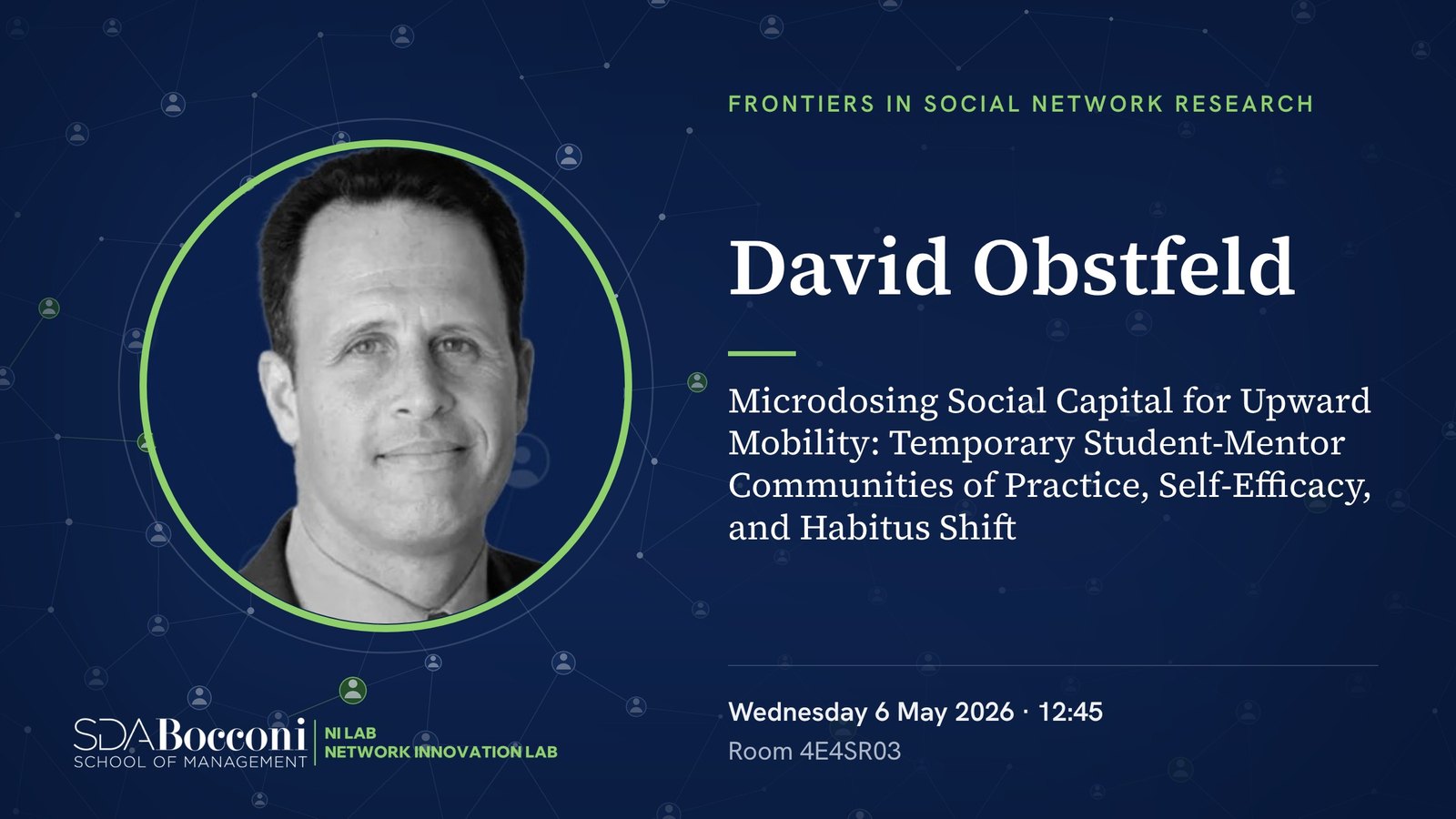
The SDA Bocconi Network Innovation Lab hosted a seminar of the series Frontiers in Social Network Research with David Obstfeld.
“Microdosing Social Capital for Upward Mobility: Temporary Student-Mentor Communities of Practice, Self-Efficacy, and Habitus Shift”
Speaker: David Obstfeld
When: Wednesday 6 May 2026, 12:45
Where: Room 4E4SR03
Abstract
Research on social capital and mobility has established that access to networks and culturally valued competencies shapes career attainment, yet the mechanisms through which individuals from less advantaged backgrounds acquire these capacities remain underspecified. We develop a theoretical framework that integrates Bourdieu’s concept of habitus with social cognitive theory, arguing that self-efficacy constitutes a micro-level mechanism through which class-based dispositions can be modified.
We test this framework using longitudinal data from a structured intervention, the Social Capital Academy, that creates a temporary community of practice designed to activate the four sources of self-efficacy. Results indicate that participation significantly improves career decision-making, perceived likelihood of securing career-related employment, and job-seeking behavior. Mediation analyses show that these effects operate primarily through increases in career mentoring perceptions, career self-efficacy, and networking self-efficacy.
These findings clarify the relationship between structure and agency in mobility processes by specifying how new dispositions toward professional action emerge. More broadly, the study suggests that exposure to social capital is insufficient absent the efficacy to enact it, and that targeted, socially embedded interventions can generate measurable shifts in trajectories typically understood as structurally constrained.