The invisible organization: Giuseppe Soda's new book, and an interview with the author
Oxford University Press has published Formal and Informal Networks in Organizations, Giuseppe Soda's book on how org charts and informal networks shape each other. In an interview, he explains what managers miss and what they can learn from it.
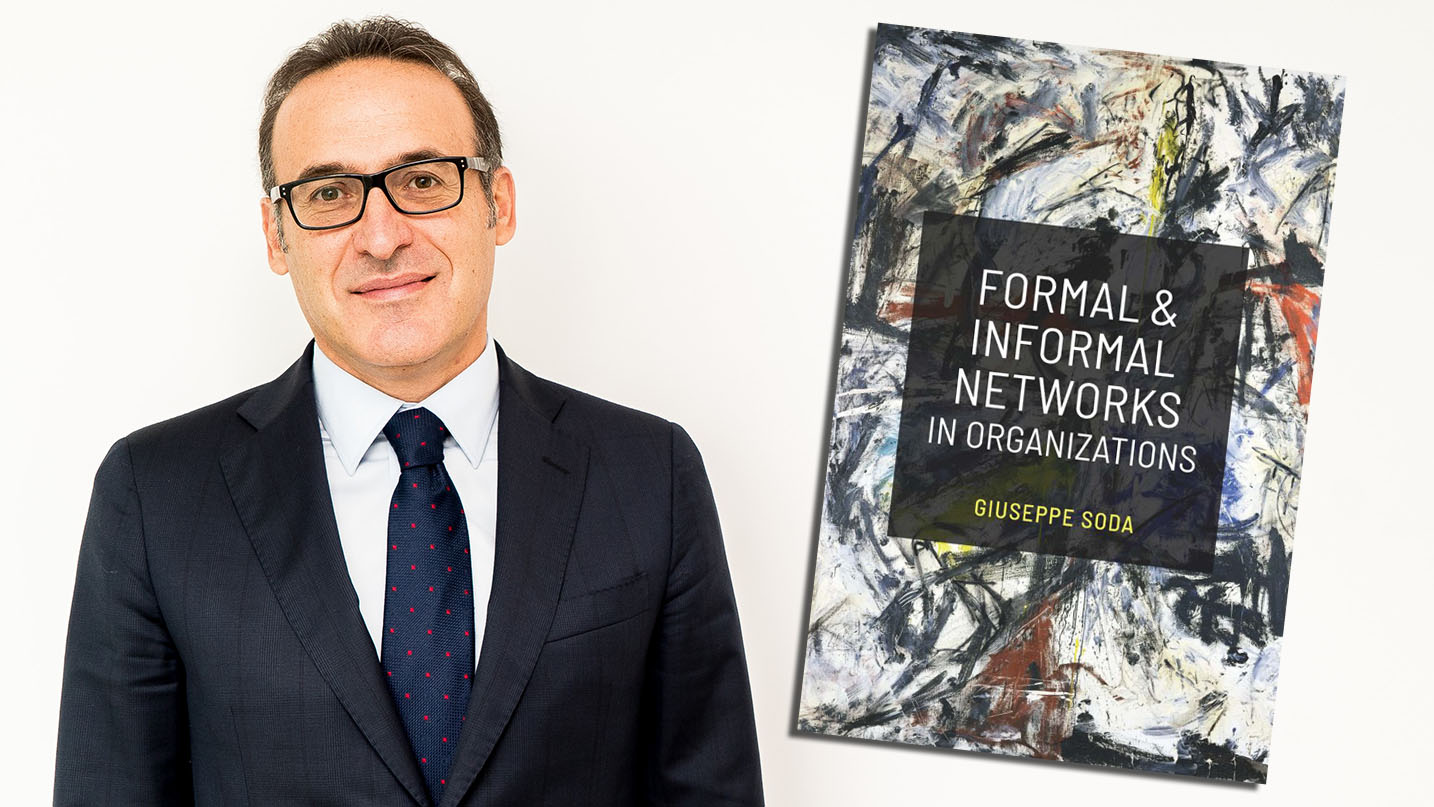
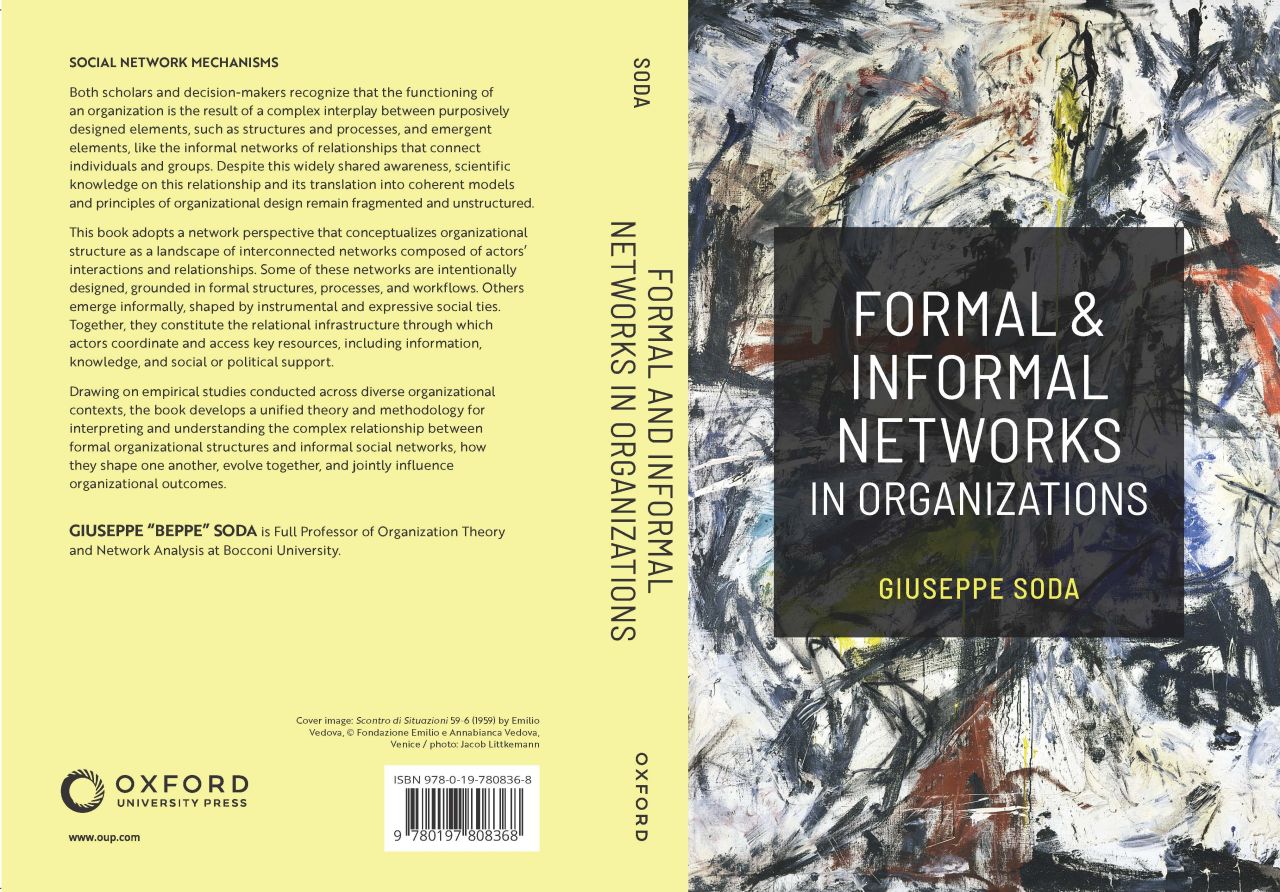
Giuseppe “Beppe” Soda’s new book, Formal and Informal Networks in Organizations, has been published by Oxford University Press in the Social Network Mechanisms series, edited by Ron Burt and Paul Leonardi.
The book: Giuseppe Soda (2026). Formal and Informal Networks in Organizations. Oxford University Press, Social Network Mechanisms series.
The book
Organizations put great effort into designing formal structures: processes, workflows, jobs, roles and HR systems. Yet how they actually work also depends on the informal networks through which people coordinate, exchange knowledge, exercise influence and find support. The two are deeply interdependent: they can reinforce each other or pull in opposite directions, but they keep shaping one another.
Despite this, formal arrangements and informal networks have mostly been studied separately, with different theories and methods. Drawing on a multi-year research program across organizations of different sizes and industries, the book brings them together with a network perspective that treats the organization as a relational system. For scholars, it offers an integrated theoretical and methodological framework. For decision-makers, it presents organization design as the search for alignment between the formal structure and the informal networks of everyday work.
The interview
The paradox at the heart of the book is what Soda calls the “invisible organization”: the informal relationships through which people collaborate, solve problems, share skills and build trust, and which can move in a different direction from the organization that was designed. For decision-makers, the challenge is not to choose between the two but to understand their balance, an issue that becomes even more important with hybrid work and artificial intelligence. In this interview with via Sarfatti 25, Bocconi’s magazine, Soda explains why.
You argue that two organizations coexist in every company. What do you mean?
In reality, there is only one organization, built on the interactions and coordination between its members. In the formal organization, these interactions are designed and “imposed from above” through hierarchies, processes and procedures. The informal component, on the other hand, consists of the relationships people spontaneously build to work, learn, ask for help or share knowledge. In both cases, we’re talking about networks of interaction between individuals and groups. Therefore, in this book, I propose a unified analytical perspective — that of networks and social network analysis — to study both components and their interdependencies.
Why do managers tend to underestimate the invisible organization?
Rather than underestimation of informal organization, I would argue for a difficulty in making it visible, understandable and usable. Managers systematically experiment with the role of informal relationships in knowledge sharing, trust and influence. What’s missing are conceptual tools, analytical models and design practices. One reason for this absence is epistemological. Formal and informal elements have often been studied separately, with distinct theories, languages and methods. This has resulted in a conceptual and methodological void. The book stems from this need: to understand the intertwining of formal structure and informal organization, and to offer tools to interpret and govern it.
You argue that today it is possible to make the invisible organization visible. How is this done?
We learned the mathematics and language of networks long ago. There exists a reliable and sophisticated body of theory and analysis that, despite its potential applications, has remained confined to the academic world. One methodological proposal in the book is to use these tools to analyze not only informal organizations, but also formal ones. This makes it possible to have a common analytical language, capable of representing organizational charts, roles, processes and social networks in the same conceptual and methodological space. This step allows for a much more accurate study of the organization and offers clearer design implications for organizational decision-makers.
When observing the overlap between formal and informal networks, what result most surprises managers?
The studies collected in the book were all conducted in real companies across different sectors. This type of research requires constant dialogue with managers and the people involved in organizational processes. The surprise arises from the fact that the mindset, language and methods of network theory are not yet widespread, nor systematically taught. Consequently, managers show a limited ability to accurately read informal networks of relationships. When these become visible, it turns out that the actual organization functions in a more complex way and sometimes very differently from prior expectations. Informal networks can operate in a complementary, supplementary or substitutive fashion, strengthening, filling gaps, compensating for rigidities or correcting imperfections in the formal organization. The methodology we have used and proposed in the book serves precisely to reduce this cognitive gap: it offers managers tools to understand not only where the relevant relationships are located, but also what function they perform within the formal design of the organization.
Informal networks are often portrayed as a resource. When do they become a problem?
There is a positive rhetoric about the informal: a long tradition of research shows that informal networks can foster innovation, collaboration, knowledge circulation and adaptation. But they can also generate closure, conformity, exclusion and resistance to change. Dense and cohesive networks, for example, can become self-referential and reject external information. In the book, I also present cases in which internal social networks have held back change, neutralizing the effects of strategic reorientations and reorganizations to protect the interests of internal coalitions rather than those of the organization as a whole.
What’s the most common mistake a manager makes when they discover the company isn’t operating as expected?
Thinking that this difference is necessarily a problem that needs to be fixed. Informal networks are often a smart response to organizational complexity. Before intervening, we need to understand what they make possible: what information they circulate, what obstacles they overcome, what skills they bring together. Organizations are ecosystems of formal and informal relationships. Those who lead them must design organizations with both in mind.
Hybrid work and artificial intelligence are changing the way we work. What is happening to relationships within companies?
This is one of the big questions of the coming years. In the book’s epilogue, I try to outline some questions that should guide scholars and decision-makers. New forms of work and artificial intelligence are not only changing the way we work, but also the way we build, maintain and transform relationships. We now have a fairly robust understanding of hybrid work: it can weaken relational networks, multiply asynchronous interactions, break weak social bonds and fragment the organization’s social structure, jeopardizing both the circulation of knowledge and the sense of belonging. Regarding the spread of artificial intelligence, emerging results highlight still conflicting trends. We need to understand whether and to what extent AI’s human-machine interactions will replace the human-human interactions upon which social networks are built.
What is the most important lesson from your research?
In the book, I included a photo of a “desire path” in a park: pathways that people spontaneously trace, leaving a mark on the lawn. The most interesting paths are not always the ones that have been designed. Even in organizations, informal networks work this way: they often arise because someone finds a more effective way to achieve a goal. Informal channels often arise to exchange information and solve problems more quickly and effectively than formal processes and structures. They appear to be deviations from the norm, but in reality, they can signal needs the formal organization is not satisfying. An executive’s question shouldn’t be “How do I eliminate this deviation?” but rather “What is it teaching me?”
Beppe also talks about the book in an episode of the Social Networks Society podcast: Beppe Soda on the science of social networks.
Interview first published in: via Sarfatti 25, 3/2026