Tied in or tied up? How workplace connections affect employee turnover
In the Academy of Management Journal, Alessandro Iorio and Shad Morris show that the link between workplace connections and turnover is U-shaped. Employees with a moderate number of ties are the most likely to stay.
Are well-connected employees more likely to stay with their organization? A new paper by Alessandro Iorio and Shad Morris (Brigham Young University), published in the Academy of Management Journal, shows that the answer depends on how many connections they have.
Two opposite effects
Workplace connections help people do their jobs. Colleagues are a source of information, advice and resources, and employees who can draw on them have fewer reasons to leave. But every connection also brings requests, messages and information to process. Past a certain point, this becomes overload, and the strain can lead people to disengage.
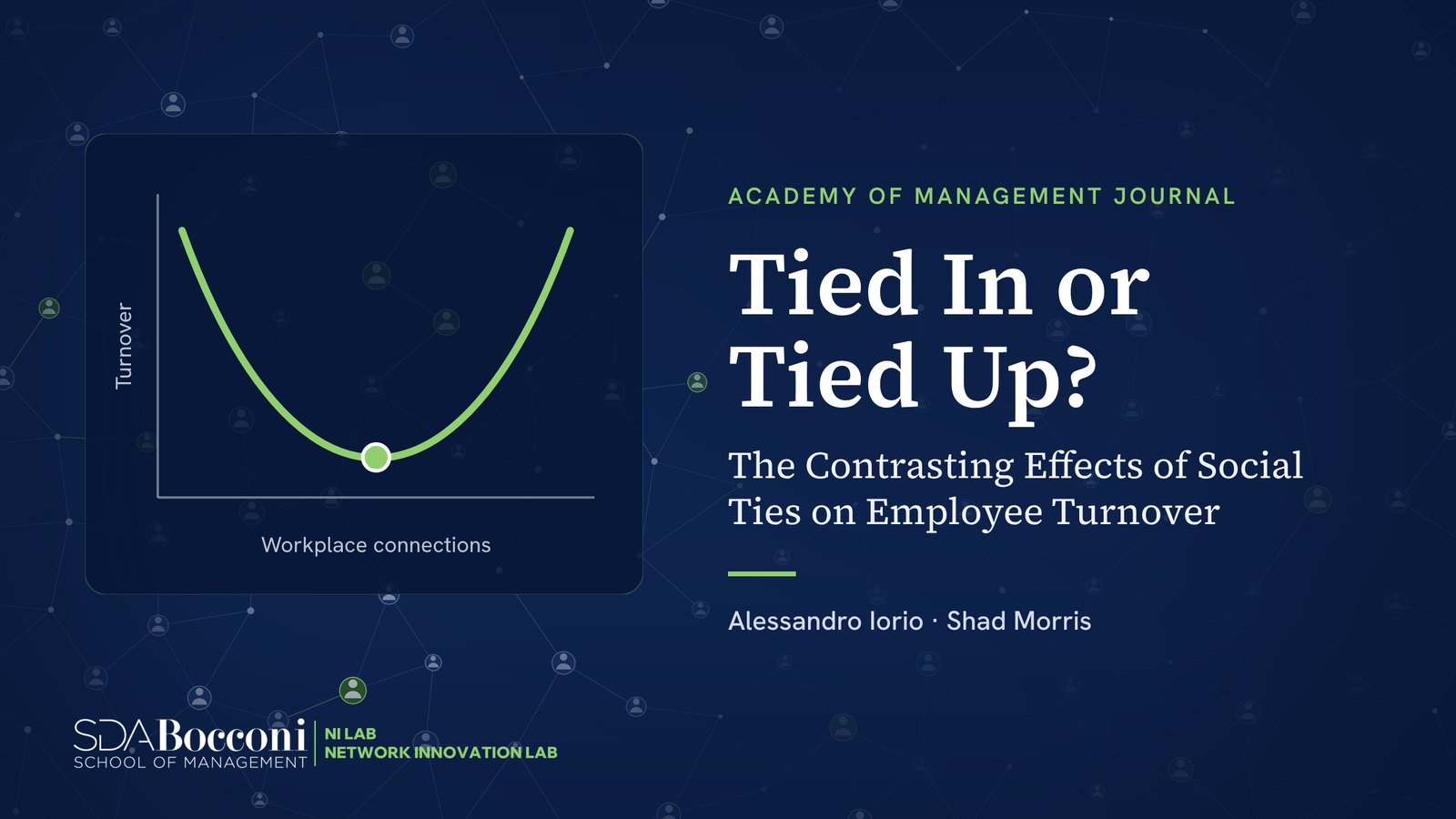
The authors bring the two effects together in one argument. As an employee’s instrumental, work-related connections grow, turnover first falls, then rises again. The relationship is U-shaped: a moderate number of connections keeps people in the organization best.
The evidence
The authors test the argument in four studies: two pre-registered experiments and two field studies of employees in large organizations.
Why it matters
The findings challenge the common view that a bigger network is always better. For organizations, encouraging people to build ties can help retention, but only up to a point. Beyond it, more connections become a burden, and the employees with the largest networks may be the ones most at risk of leaving.
The paper: Iorio, A., & Morris, S. (2026). Tied in or tied up? The contrasting effects of social ties on employee turnover. Academy of Management Journal, 69(5): 1044-1075.